January 2026


feature
Get better faster
16th Annual ASA NETWORK Supply House Times Distributor Roundtable.
By Natalie Forster

The past several years have trained distributors to operate in a constant state of adjustment. Pricing volatility, supply-chain disruption, labor shortages, inflation and shifting customer expectations have all collided at once, compressing decision timelines and shrinking the margin for error. Against that backdrop, five distributors gathered in November at ASA NETWORK in Fort Lauderdale, Fla., for Supply House Times’ 16th annual distributor roundtable to take stock of where the market stands and what it will take to succeed through what comes next.
If one phrase captured the tone of the conversation, it was this: Get better faster. Not bigger for the sake of size or flashier for the sake of technology, but faster at learning, adapting, and executing without losing the relationships and values that have long defined independent distribution.
Moderated by Editorial Director Natalie Forster, the discussion included Matt Huffman, manager/partner of Dallas, Texas-based National Wholesale Supply; Doug Wright, vice president of business development for Kent, Washington-based Puget Sound Pipe & Supply; Mike Meiresonne, chief operating officer at Plymouth, Minnesota-based DSG; Zachary Derr, vice president of supply chain at Lebonan, Pennsylvania-based APR Supply Co.; and Kyle Sanders, president of Wheat Ridge, Colorado-based George T. Sanders Co. While their geographies and customer mixes varied, the themes that emerged were strikingly consistent.
Commercial strength
Across the board, participants pointed to commercial markets as a continued source of opportunity, particularly in data centers, healthcare facilities, battery plants and other mission-critical projects. But distributors explained that the nature of opportunity in the commercial segment has changed.
Wright described how the Seattle market shifted dramatically after years of intense construction activity. “At one point, I counted 60 tower cranes in downtown Seattle,” he said. “Now there are two.” That slowdown forced Puget Sound Pipe & Supply to rethink how and where it grows.
Rather than waiting for local demand to rebound, Wright said his team began following contractors into other regions, fabricating in Seattle and shipping material nationwide. “Chasing data centers and battery plants around the country has forced us to step outside our box,” he said. “We’ve been fortunate to be part of that growth, but it requires flexibility.”
Huffman echoed that sentiment from a Southern perspective. Operating across Texas, Oklahoma, Louisiana and Arkansas, National Wholesale Supply continues to see strong commercial demand, including a $3 billion hospital project near its headquarters. “Commercial has remained strong,” Huffman said. “Texas continues to grow.”
At the same time, residential softness and uneven multifamily activity have sharpened the contrast between markets. Meiresonne noted DSG’s diversification across residential and HVAC has helped stabilize performance, even as certain construction segments slow. “We’re cautiously optimistic,” he said. “We haven’t really seen a slowdown in our markets, and diversification is holding the line.”
These distributors agree that while opportunity exists, it is increasingly targeted. Winning jobs requires agility, being technically capable, and a willingness to follow customers wherever the work goes.
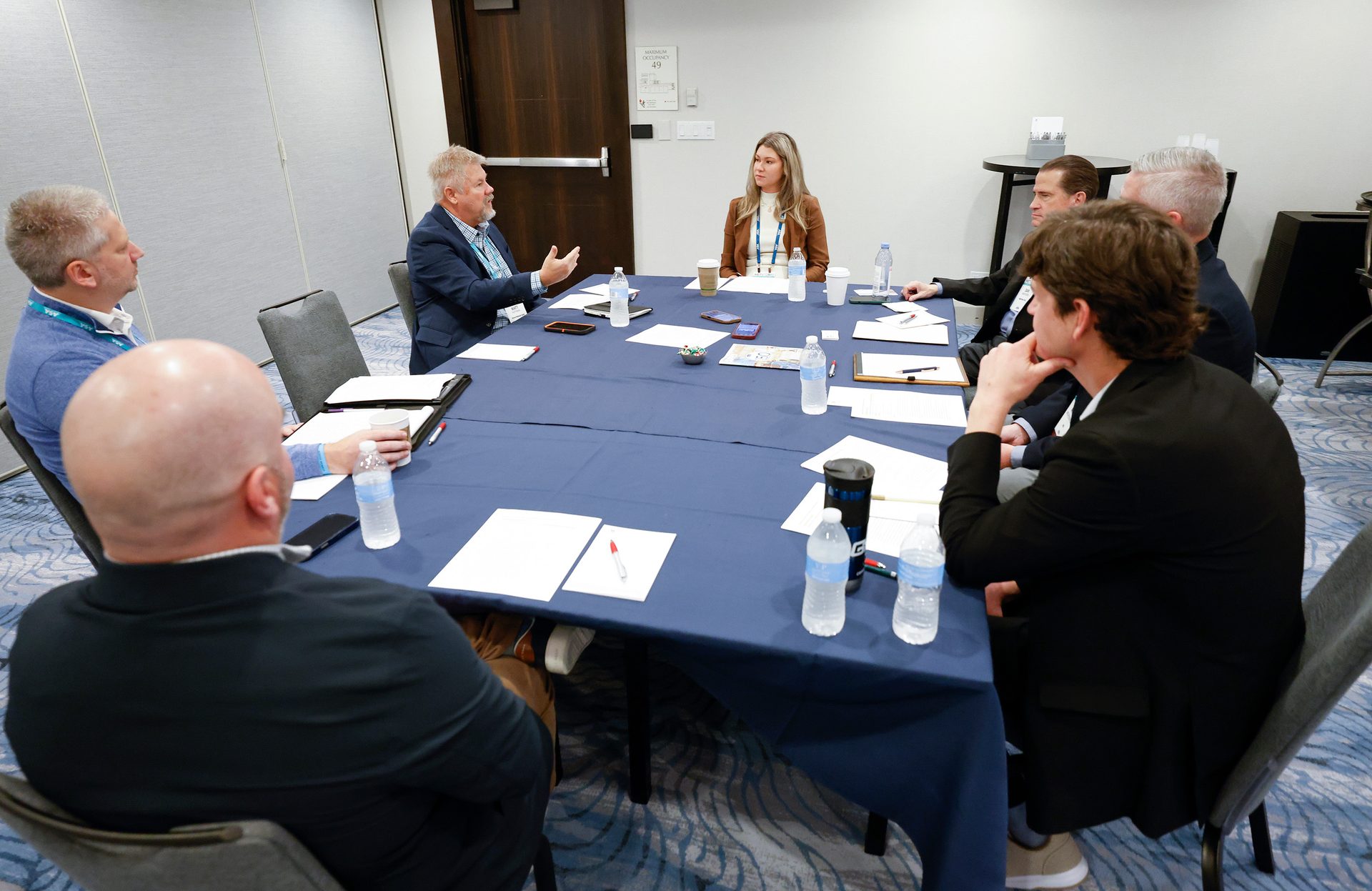
The 16th annual exclusive roundtable was held at ASA NETWORK in Ft. Lauderdale, Florida this November. Photos by Steve Woltmann
The hangover effect of uncertainty
Despite pockets of growth, several distributors described a market that feels fatigued after years of unknowns. Huffman compared the current environment to a hangover from prolonged volatility. “You can’t forecast like you used to,” he said. “Thirty or forty years ago, you could look out a year and be pretty close. Now, you can’t.”
Derr described that while APR Supply has benefited from diversification into commercial work, residential new construction has softened under the weight of higher interest rates. “People are sitting on low rates and not moving,” he said. “That slows everything.”
Meiresonne added that while spending hasn’t collapsed, customers are more deliberate. “People with money are still spending,” he said. “But the pace and confidence aren’t what they were.”
Several participants noted that earlier buy-forward activity, driven by tariffs and inflation fears, gave way to a flatter second half of the year. The issue wasn’t demand disappearing, but rather customers pausing to reassess exposure and timing.
advertisement
advertisement
Pricing reality
Perhaps the most notable shift discussed at the table was how customers respond to pricing in today’s market. Changes and increases that once triggered shock and resistance have become part of the operating reality.
“Contractors are used to it now,” Huffman said. “The shock factor isn’t what it used to be.” Instead of debating increases, conversations have shifted toward risk allocation and price guarantees.
Wright explained that many contractors now ask distributors to lock in pricing for the duration of a project, including protection from future tariffs. “Those are lofty requests,” he said. “And they’re not always realistic.”
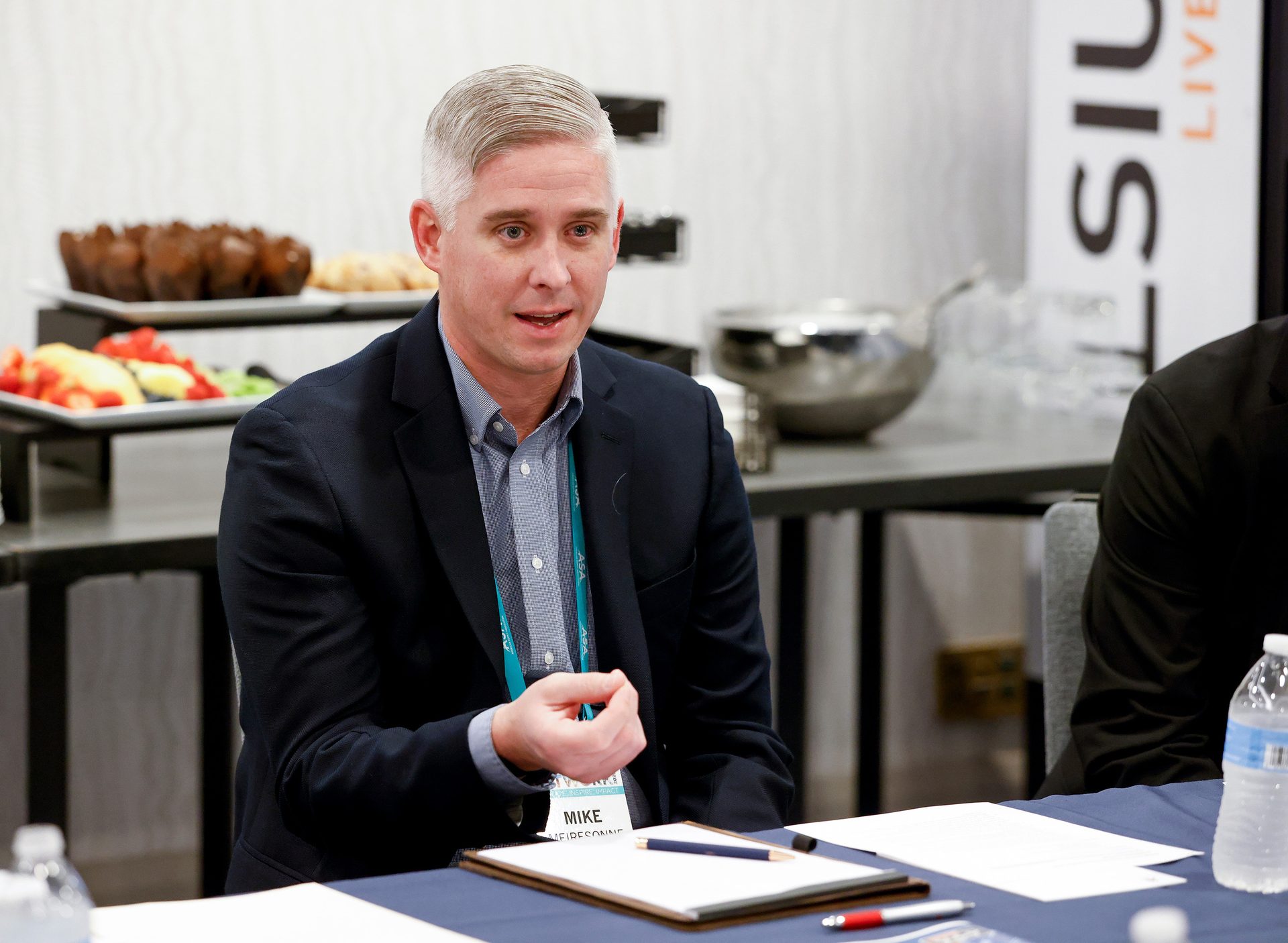
Mike Meiresonne of DSG makes a point to the group
Derr described how builders’ fear of inflation has led to early draws and faster payments, helping distributors manage carrying costs even as uncertainty persists. “Inflation has been part of our operations for years now,” he said. “Our staff is immune to it.”
At the same time, margin pressure remains intense. While some materials, such as plastics, have deflated, operating costs continue to rise. “Margins are tighter because everything costs more,” Meiresonne said. “You have to create productivity somewhere to make up for it.”
Who owns the relationship?
As pricing stabilized, attention turned to a deeper concern: disintermediation. Several distributors expressed unease about manufacturers and contractors growing closer, potentially sidelining traditional distribution.
“Technology is bringing manufacturers and contractors closer together,” Huffman said. “That buying relationship is changing.”
Wright pointed to generational shifts in buying habits as another pressure point. “New buyers don’t always understand the value proposition of long-term partnerships,” he said. “It can become more price-driven.”
Despite worries around the table, the conversation was not defeatist. Several participants emphasized the distributor’s evolving role as mediator, expected to manage expectations between manufacturers struggling to scale production and contractors demanding speed, making the wholesale-distributors’ role in the supply chain even more valuable.
“We’re playing referee sometimes,” Wright said. “Trying to dictate schedules and explain realities on both sides.”

National Wholesale Supply’s Matt Huffman emphasizing the importance of human connection in today’s AI-heavy marketplace
Speed, technology and the 'Amazon effect'
Customer expectations around speed dominated much of the discussion. Influenced by consumer platforms like Amazon and Uber Eats, contractors increasingly expect near-instant responses.
“Business happens faster now,” Meiresonne said. “And the window to perform is much shorter.”
To meet those expectations, distributors are continuing to invest heavily in technology. But that market is becoming more saturated. From AI-driven quoting tools to vendor-managed inventory and on-site material management, choosing the right tools has become its own challenge.
“There are so many players in the AI space,” Meiresonne said. “You don’t know who’s going to be around.”
Wright described using AI not just for quoting, but for internal communication and engagement, helping teams absorb information in formats that resonate with younger employees. Derr noted that while AI adoption is inevitable, it must be paired with clean data and thoughtful integration.
At the same time, participants stressed that technology cannot replace human connection. Huffman reminded us that a simple, quick phone call still gets the job done. “Pick up the phone,” he said. “You learn more in a conversation than in a text or an email.”
Sanders agreed, arguing that personal communication may soon become a differentiator simply because it is so rare. “When something’s really wrong, and you get a call back from a human who knows what they’re doing,” he said, “it separates you.”
“Chasing data centers and battery plants has forced us to step outside our box — and that flexibility has been critical to our growth.” – Doug Wright, Puget Sound Pipe & Supply
As speed expectations rise, distributors are embedding themselves deeper into customer operations. VMI programs, consignment inventory and onsite material management are no longer fringe services.
Sanders noted that contractors increasingly recognize when distributors are better at logistics than they are. “They’re good at installing,” he said. “We’re good at managing material, and they’re relying on us more than ever for that.”
That deeper integration creates relationship protection in a competitive landscape where loyalty can evaporate overnight.
M&A and the independent advantage
Consolidation across distribution, manufacturing and contracting surfaced repeatedly throughout the roundtable discussion. While M&A can threaten long-standing relationships, several participants noted it can also strengthen independents’ positioning.
Derr observed that as competitors are acquired, APR Supply’s identity as a high-service, family-oriented business becomes clearer. “It actually strengthens who we are,” he said.
Meiresonne and Huffman both described how private equity ownership on the contractor side can dramatically alter dynamics, sometimes reducing margins and service expectations despite higher volumes. “Revenue grows, but volatility increases,” Meriesonne said.
In those moments, independence and decision-making speed remain advantages to the independent distributor. “We can flip a switch,” Huffman said. “We don’t need ten layers of approval to get something done.”
“Personal, human communication may soon be a differentiator simply because it’s so rare.” – Kyle Sanders, George T. Sanders Co.
The long game
As the conversation wound down, attention shifted to labor and leadership. Across all five companies, culture emerged as the most powerful retention tool.
“People want to work where they feel valued,” Wright said. He described investing intentionally in engagement and culture initiatives to keep teams connected.
Huffman framed leadership as stewardship. “Good people do good things,” he said. “If you take care of your people, they’ll take care of your customers.”
Recruitment strategies ranged from trade-school partnerships to high-school programs and employee referrals, but the philosophy was consistent: show people a path, invest in them and let them grow.
The value of coming together
As the roundtable concluded, the group reflected on the fact that many of the most candid insights shared throughout the discussion were made possible by the environment itself — the opportunity to gather in person at events like ASA NETWORK. Stepping away from daily pressures created space for honest conversations about what’s working, what’s changing, and what keeps distributors up at night.
“You don’t get these conversations when you’re just trying to get through the week,” Huffman said. “You need time with people who are dealing with the same things.”
ASA continues to provide that space, bringing distributors together not just to share best practices, but to learn from one another’s experiences in real time. For the distributors in this room, that peer-to-peer exchange is increasingly valuable as decision cycles shorten and uncertainty becomes the norm.
“When you get distributors in a room like this, you realize you’re not alone,” Wright added. “A lot of us are facing the same challenges, even if our markets look different.”
When asked to look ahead and define what will ultimately make the distributor of tomorrow successful, the answers echoed many of the themes that surfaced throughout the discussion. Speed and technology matter, but only when paired with strong relationships and sound judgment. “Business happens faster now,” Meiresonne said, “but you still have to get it right; we need to be more accurate than ever.”
Several participants also pointed to the importance of staying engaged with peers and industry partners through organizations like ASA. “The ability to step back, compare notes and learn from each other is huge,” Sanders said. “That perspective helps you go back to your business better prepared to make decisions.”
In a business defined by constant change, getting better faster doesn’t happen in isolation. It happens when distributors show up, exchange perspectives, and leave a little more prepared than they arrived.
ABOUT THE AUTHOR: